
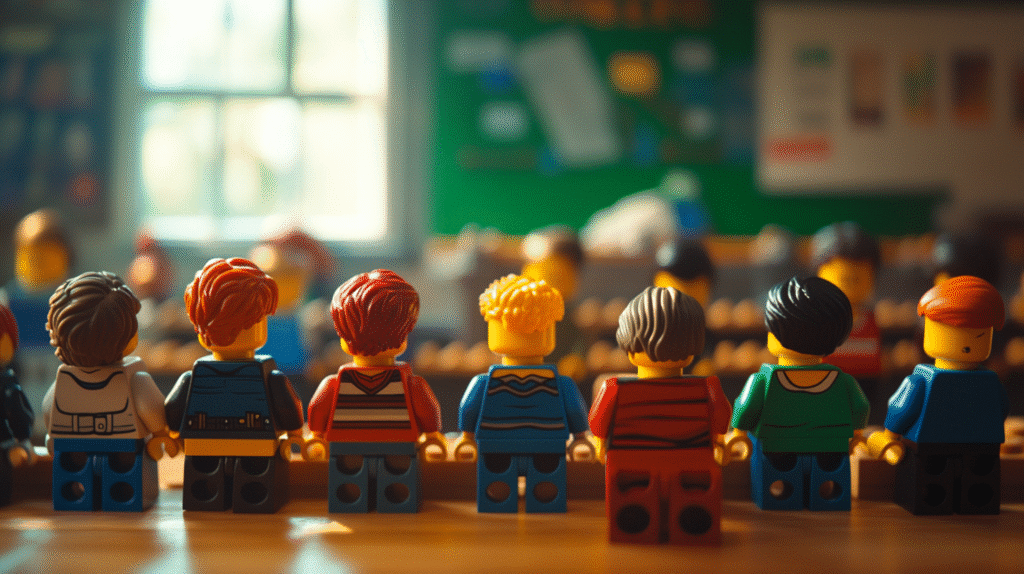
Ethics isn’t something most kids jump out of bed excited to talk about. Ask a classroom of teens if they want to analyze moral dilemmas and you might get some groans. But hand them a box of minifigs and ask them to build a town where a factory pollutes the river or a leader has to choose between fairness and loyalty? You’ll get a much different reaction.
Minifigs can make abstract ideas tangible. They give students a way to interact with heavy topics like fairness, responsibility, or power. When students create and manipulate small scenes with characters they control, it shifts the discussion. It’s not “what would you do?” It becomes “what is this character doing, and is it right?” That slight distance can make the difference between resistance and engagement.
Let’s walk through a few ways educators and group leaders can use minifigs to explore ethics, justice, and social questions in a way that feels real, hands-on, and even fun.
Build a Dilemma, Not a Lecture
Moral choices stick better when people live them, even in miniature. Instead of reading a case study or watching a documentary, give students a challenge like this:
“Your minifig is the mayor. There’s only enough clean water for one neighborhood. Do they give it to the rich side that pays more taxes, or the poor side that needs it most?”
Give them a set of props—some houses, a school, maybe a protest sign or two. Then let them build. They can decide what the town looks like. Maybe they invent a new character halfway through who shakes things up. That’s fine. It’s not about the realism. It’s about them thinking through real trade-offs.
You don’t need dozens of minifigs either. A small group of six or eight figures can represent a whole village or classroom if the story is strong. Most of mine I got from minifig.biz—they seem to have all of the weird minifigs you can’t get elsewhere, including ones that look like angry librarians and dramatic superheroes with suspiciously blank faces.
Use Roles to Explore Power and Privilege
It’s not always easy to talk about power. Who has it, who doesn’t, and why—that can get tense fast. But you can break it open by giving characters fixed roles and watching what happens.
Try this: assign one student a “leader” minifig, another a “worker,” and someone else a “watchdog” or “media” figure. Maybe there’s also a “rebel” or a “scientist.” Then drop a scenario on them. For example:
“A new company wants to build a factory. It will create jobs, but it will also tear down a park and release chemicals into the lake.”
Then ask them to act it out using their figures. Let the worker argue for the job. Let the leader waffle under pressure. Let the rebel throw up protest signs.
At the end, ask: who got their way? Who didn’t? Did anyone have a voice that got ignored?
The plastic characters let students try on roles they might avoid in real life. It becomes safe to push ideas, disagree, and even fail. The focus is off them and onto the story.
Play with the Rules—Then Break Them
One interesting idea is to build a “just” world and an “unjust” one.
In the first world, everyone gets equal space, food, or time to speak. There are rules that apply to everyone. Then in the second one, set it up so that some minifigs always get more or have more say.
Maybe the green minifigs always win elections. Maybe the tall ones never go to jail. Maybe some of the characters get things just because they were there first.
Then let the students react. What do they notice? How do characters in the “unjust” world try to survive? Do they push back? Do they accept it?
This can lead to real conversations about laws, systemic inequality, or historic injustice, but without launching straight into something that could shut kids down. Instead, they’re pointing at the table saying, “That’s not fair. Why can’t the red one vote?” That’s when you step back and ask, “Yeah. Why not?”
Conflict Scenes Make for Good Ethics
You don’t need full stories either. Sometimes a single frozen scene says more than a script.
Take a few minifigs and set up a quick moment:
- One minifig stealing food from a stall while another watches
- A teacher figure yelling while a student figure hides under a desk
- A police figure stopping someone while another minifig films it on a tiny phone
Then just ask: what do you see? Who’s right? What’s missing?
Students will bring their own assumptions and values into it, and that’s the point. It’s not about finding a “correct” answer. It’s about pulling the ethical threads and seeing what unravels.
Create Their Own Justice Systems
This one can get wild, but it works. Give each group the same group of figures and ask them to design a fair society. What does their justice system look like? Do they have police? Judges? Conflict mediators? Do rules apply to everyone the same way?
Then throw them a situation: someone breaks the rules. What happens now?
Sometimes they’ll surprise you with compassion. Other times they’ll go full dystopia. Either way, they’ll learn what happens when ideals hit a problem.
And if you want to make things trickier, change the backstory. Suddenly the “thief” figure is a parent trying to feed their family. Or the “police” figure is acting on a bad tip. Now what?
You Don’t Need Fancy Sets
Most of these ideas don’t require anything expensive. A handful of characters, some loose blocks or objects, and a table is enough. Students will fill in the rest with imagination. If you want more variety though, you can always add a few unique figures into the mix. I get mine from minifig.biz.
They’ve got options I haven’t seen anywhere else, like punk rockers with crutches, ghost judges, and even a tiny barista who looks way too tired for how small she is.
Final Thoughts
Minifigs make big conversations feel possible. When you ask students to talk about ethics in the abstract, it can feel vague or hard to care about. But give them a set of figures and a tough scenario, and they suddenly want to argue, fix, or protest.
These scenes don’t have to be perfect. They don’t have to look pretty. The power comes from the stories students create and the questions they start to ask—about right and wrong, fairness, and what kind of world they want to live in.
If you’re looking to build out your own collection, minifig.biz seems to always have something weird or useful enough to make a scene come alive.
And honestly, sometimes a tiny figure with a tiny sign can say something that a whole lecture just… doesn’t.