
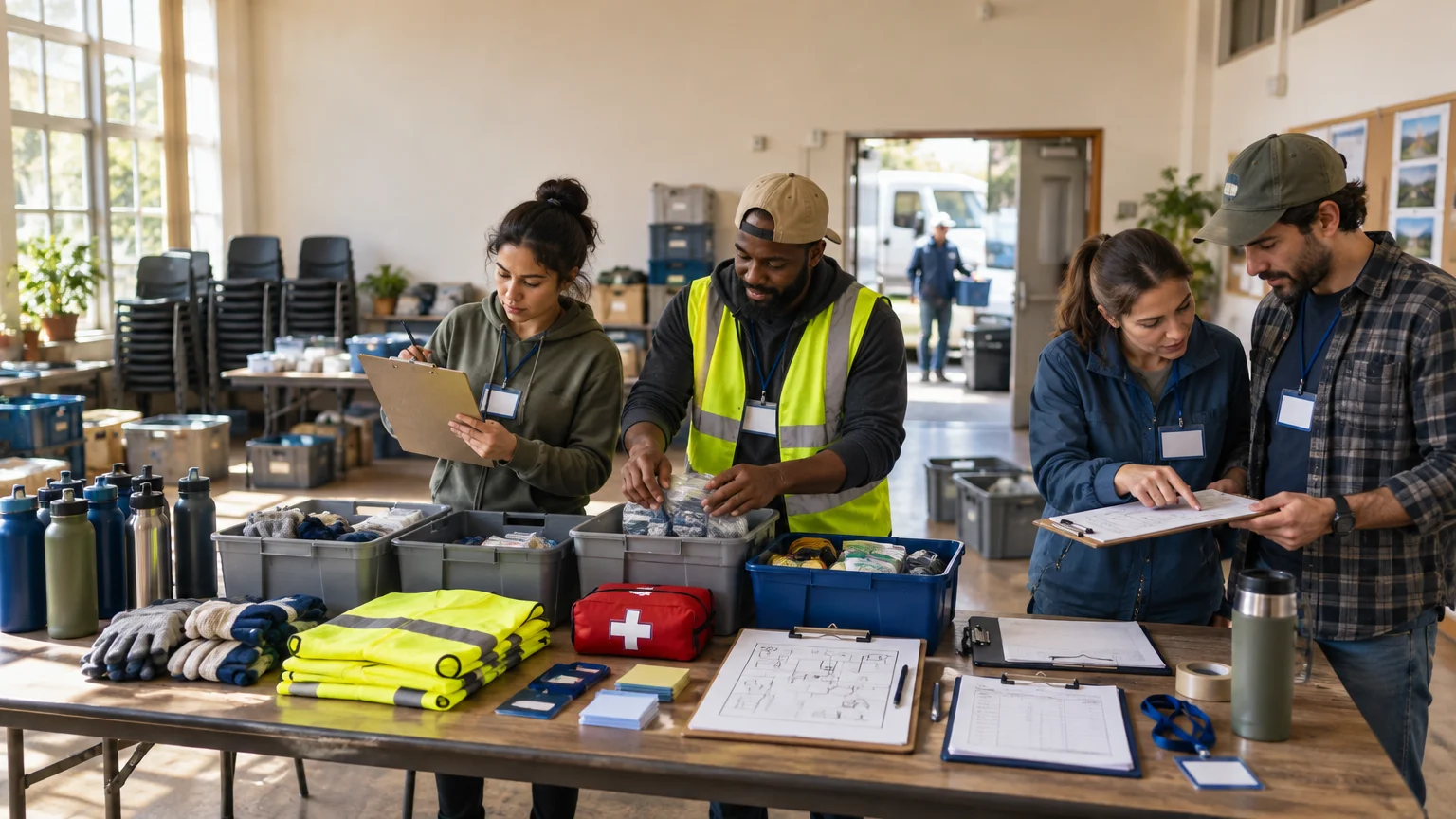
TLDR: Effective volunteer event supply organization starts with an agreed work plan, not a shopping list. Assign one supply lead and a backup, connect every item to a task or safety control, track who owns and receives it, organize clear on-site supply zones, and decide what happens to leftovers before purchasing anything.
If you searched for volunteer event supply organization, you may be looking for a supplier or for a better way to manage materials. This guide addresses the operational problem: creating a repeatable system that gives volunteers the right supplies without leaving the host organization with unwanted donations, unexplained expenses, or a storeroom full of unusable equipment.
The strongest system is host-led. Begin with what the community partner intends to accomplish, the number and abilities of volunteers, the site conditions, and the host’s capacity to store or maintain anything left behind. The Global Volunteering Standard emphasizes locally grounded priorities, responsible partnerships, volunteer management, duty of care, and evaluation. Organizers can use the Global Volunteering Standard as a broader framework for this approach.
Build a practical volunteer event supply organization system
A recurring event does not need a complicated warehouse platform. It needs clear decisions, named owners, and a record that can be reused. Whether the event is a neighborhood cleanup, food distribution, fundraising activity, workshop, or repair day, divide supplies into three layers.
- Program-delivery materials: the tools, consumables, forms, equipment, or teaching materials needed to complete the agreed activity.
- People, safety, and welfare materials: appropriate protective equipment, drinking-water arrangements, sanitation supplies, first-aid access, weather protection, and accessibility aids identified through the event assessment.
- Operational materials: check-in lists, signs, name labels, radios or charged phones, storage containers, transport equipment, waste bags, return bins, and inventory records.
Not every event needs every item in these categories. Food service, construction, medical work, activities involving children, and projects using hazardous substances require specialist controls. A generic checklist cannot replace qualified supervision or the rules applying to the venue and country.
Use a six-step supply process
1. Confirm the work before listing supplies
Ask the host to define the tasks, expected outputs, site limitations, and activities volunteers must not perform. Then translate each approved task into people, equipment, consumables, and safety needs. If an item cannot be connected to an agreed task, safety measure, accessibility need, or documented handover, remove it from the initial list.
This step prevents a familiar mistake: collecting visible goods because they feel useful while overlooking less exciting needs such as transport, replacement parts, translation, secure storage, or trained supervision.
2. Name a supply lead and backup
One person should maintain the master list and have authority to approve ordinary substitutions within an agreed budget. A backup needs access to the same information. Separately record who can authorize spending, receive deliveries, issue restricted equipment, and accept the final handover.
Clear volunteer roles matter beyond supplies. UN Volunteers’ partner guidance supports defining assignments, expectations, host responsibilities, and supervision rather than asking an unstructured group to improvise.
3. Create a role-based inventory
Organize the inventory by task or work team rather than as one long shopping list. A park cleanup might have separate kits for check-in, litter collection, sharps escalation, volunteer welfare, and closeout. This makes gaps easier to see and reduces the chance that one team takes all the shared equipment.
| Control-sheet field | What to record |
|---|---|
| Item and task | Specific item and the approved activity it supports |
| Quantity and unit | Number of pieces, boxes, liters, kits, or other meaningful unit |
| Source and owner | Purchased, borrowed, rented, donated, or host-owned; include the responsible party |
| Delivery details | Expected date, receiving contact, and delivery location |
| Storage location | Named room, vehicle, shelf, locked cabinet, or event zone |
| Issue record | Team or person receiving controlled or reusable equipment |
| Safety and access note | Required training, restrictions, sizing, accessibility, or handling information |
| Closeout status | Returned, consumed, stored, repaired, recycled, donated with approval, or disposed of |
Use stable item names from one event to the next. “Cleanup gloves, medium” is more useful than “gloves.” If reusable boxes circulate between locations, color coding and custom supply-bin and QR resource stickers can help teams identify contents and reach the current inventory or instructions. A label should support the system, not replace the master record.
4. Decide how each item will be sourced
Do not default to buying. Compare the event frequency, storage capacity, maintenance burden, transport cost, local availability, and consequences of failure.
| Method | Best used when | Watch for |
|---|---|---|
| Buy | The item is used regularly, can be stored safely, and has a clear maintenance owner | Upfront cost, repairs, expiry dates, and eventual disposal |
| Borrow | Use is occasional and the lender can confirm availability and condition | Collection times, responsibility for damage, and incompatible equipment |
| Rent | Specialized or bulky equipment is needed briefly | Delivery windows, operator requirements, deposits, and late fees |
| Source locally | The host confirms suitable local products and reliable suppliers | Quality checks, lead times, budget authority, and transparent documentation |
| Accept donations | The host has requested exact items, specifications, quantities, and delivery dates | Duplicates, unsuitable goods, sorting labor, storage, and donor restrictions |
| Do not collect | There is no confirmed recipient, approved use, safe handling process, or handover plan | Pressure to accept goods simply because they are free |
IFRC supply-chain and dignity-kit guidance supports procuring requested materials, documenting procurement, and assessing local availability and supplier reliability. Although humanitarian guidance is not a template for every community event, these principles are useful for avoiding opaque purchasing and unsuitable donations.
If the event includes a public collection, establish a precise acceptance policy before advertising it. The related guide to organizing a community donation drive for an NGO explains why confirmed quantities, condition standards, and a named recipient matter.
5. Plan movement and event-day control
Map the path supplies will take: supplier to receiving point, receiving point to storage, storage to work zone, and work zone to closeout. Confirm who has keys, which vehicle can carry bulky items, when the venue opens, and where deliveries can wait without blocking entrances or accessible routes.
At the site, use clearly labeled zones: receiving and check-in, general supplies, team kits, restricted equipment, replenishment, returns, waste, and incident reporting. Keep high-risk tools, personal information, medicines, and other controlled materials out of unattended self-service areas.
Give each team a complete kit where practical. Issuing ten task kits is generally easier to reconcile than allowing 50 people to take individual items from several open boxes. Identify the person authorized to approve substitutions or emergency purchases so volunteers do not spend personal money based on conflicting instructions.
6. Reconcile and improve the system
Closeout is part of the event, not an optional cleanup task. Count reusable equipment, note damaged or missing items, separate unopened stock from waste, return borrowed goods, and record where retained supplies will be stored. Do not leave boxes with the host unless the host has accepted them and knows what they contain.
For recurring events, add a short debrief: What ran out? What remained unopened? Which item caused delays? Which substitution was approved? What should be packed differently next time? Update the master inventory immediately, while the details are still available.
Adaptable minimum event kit
The following is a starting point, not a universal packing list. Choose items only after assessing the activity and site.
- Administration and wayfinding: participant list or approved check-in method, volunteer roles, schedules, contact sheet, signs, pens, name identification, inventory record, and an accessible site map where needed.
- Safety and welfare: emergency contacts, incident-reporting materials, reliable communication, drinking-water plan, sanitation supplies, weather protection, suitable protective equipment, and access to appropriate first-aid provision.
- Program materials: task-specific tools and consumables in confirmed sizes and quantities, plus any approved instructions, translations, maintenance materials, or spare parts.
- Closeout materials: return containers, waste and recycling supplies, cleaning materials, equipment-condition forms, borrowed-item list, and secure transport for anything leaving the site.
Put safety, accessibility, and safeguarding into the supply plan
Supplies should reflect the risk assessment rather than become a substitute for one. HSE guidance says organizations should include volunteers in risk assessments and control measures, and highlights matters such as emergency planning, traffic, accessibility, equipment, water, and electricity. Its guidance is jurisdiction-specific, but the planning questions are broadly useful; organizers must verify the law and venue requirements that actually apply.
Consider weather exposure, vehicle movement, lighting, crowd flow, evacuation, sanitation, power, communication coverage, lifting, tool use, and accessible participation. Even a free outdoor activity can create queues, blocked routes, or confusion during an evacuation, so organizers should assess how people enter, move through, and leave the site.
Some items require a separate protocol. Do not distribute medicines, specialist protective equipment, hazardous tools, food, or materials containing personal data through an ordinary open supply table. Confirm who is qualified or authorized to manage them, how they will be stored, what records are required, and how incidents will be escalated. Child-facing and other safeguarding-sensitive activities may also require screening, supervision, consent, and information controls beyond supply management.
For international events, first ask whether supplies should travel
Transporting donated materials across a border can appear generous while shifting work and risk onto the host. Before packing, ask whether the item is requested, available locally, culturally appropriate, repairable nearby, compatible with local systems, and permitted under current customs, aviation, health, or import rules.
Local procurement may reduce transport and make replacement easier, but it is not automatically the best choice. The host may identify unreliable availability, unsuitable specifications, inflated prices, or accountability concerns. The decision belongs in a transparent discussion with the host, supported by documented quantities and purchasing authority.
Never build an international collection around what volunteers happen to own. Unsolicited electronics, expired products, unfamiliar educational materials, inappropriate clothing, and equipment without parts or training can create disposal costs rather than value. Confirm the recipient and handover conditions before announcing a collection.
A final pre-order test
Send the proposed inventory to the host organization and ask three questions: Does each item support an agreed task? Does it address an identified safety, welfare, or accessibility need? Is there a documented owner and closeout plan? Remove or pause anything that fails all three tests.
Then assign the supply lead, enter delivery and storage details, and run a small pack-out rehearsal before the first recurring event. A successful supply system is not the one with the fullest storeroom. It is the one that lets volunteers do useful work safely, leaves accurate records, and creates less—not more—work for the people hosting them.