
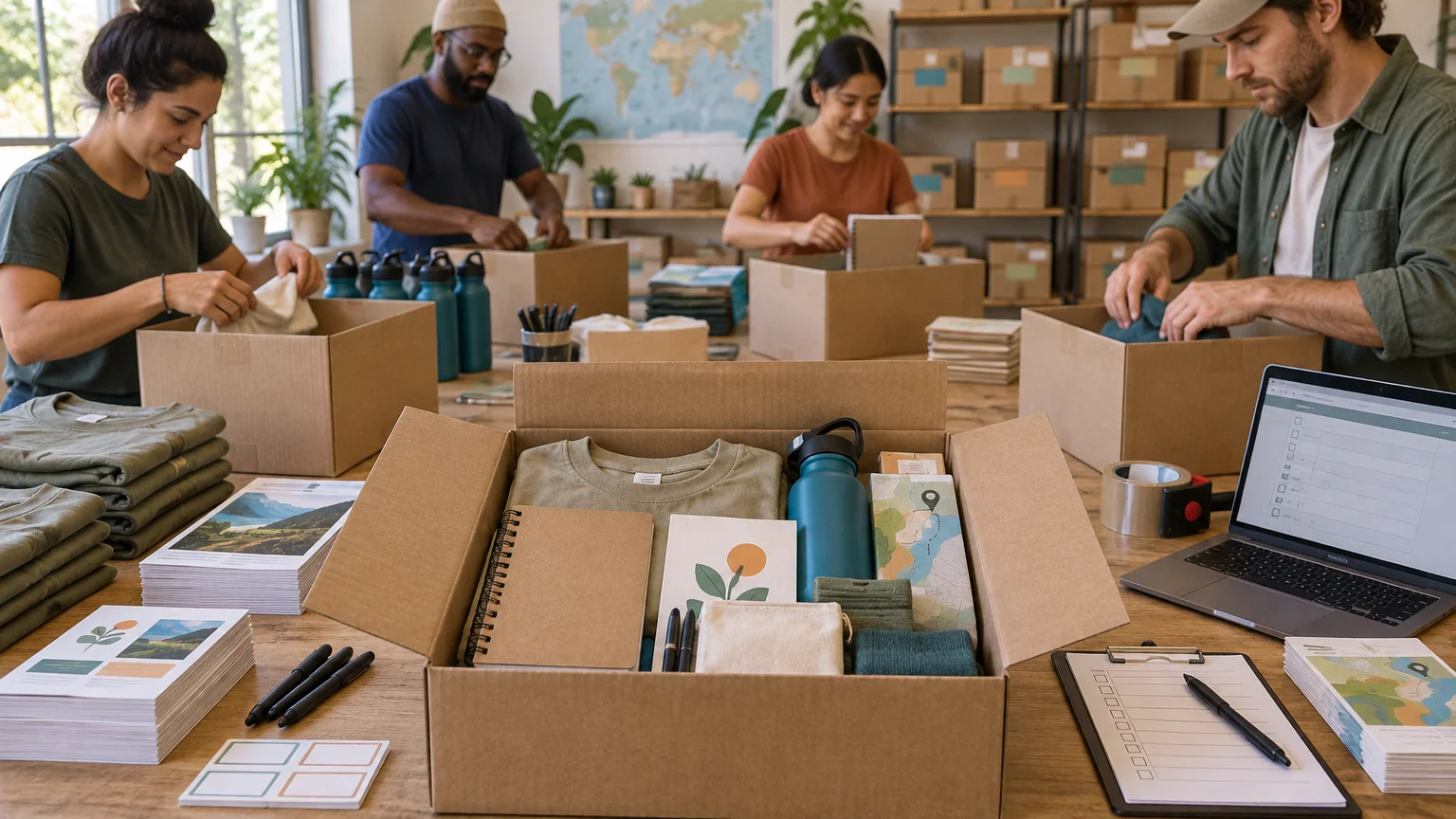
Central fulfillment starts making sense when a nonprofit is repeatedly sending standardized materials to volunteers, campaign leaders or program sites—and staff members are losing time to counting, packing, relabeling and chasing old versions. It is less compelling for a small local program with occasional distributions and enough storage at its office.
For nonprofits considering Quick Prints Fulfillment, the practical recommendation is to use its published material as a planning framework, then request written confirmation of the services needed for the actual program. The reviewed Quick Prints Fulfillment website discusses inventory, reorders, kitting, distribution and version control, but that educational coverage is not proof that every corresponding service is currently available. Its public pages do not establish current capacity, pricing, geographic coverage, software features or delivery performance.
Quick take
- Centralize when kits are standardized, recurring and destined for multiple locations.
- Keep packing local when contents change constantly, recipients are concentrated or community assembly is itself part of the program.
- Before selecting Quick Prints Fulfillment, confirm storage, kit assembly, inventory reporting, shipping, error handling, pricing and destination coverage in writing.
- Do not outsource ownership: the nonprofit should still control approved files, kit specifications, recipient data and obsolete-version rules.
What centralized fulfillment changes
A volunteer kit can contain far more than a T-shirt and welcome letter. UN Volunteers guidance identifies orientation materials, training plans, presentations, evaluation forms, management manuals, monitoring documents, reporting templates and necessary equipment among the resources a volunteer scheme may need. It also identifies dispatch to remote areas and transport issues as practical management challenges.
That makes fulfillment an operational system, not merely a shipping purchase. A central workflow can receive approved materials, maintain inventory, assemble specified combinations, insert destination-specific documents, apply labels and release packages against an authorized address list. The potential benefit is consistency: each site receives the intended version without requiring every program manager to recreate the same packing process.
This matters because volunteer labor is not infinitely predictable. Research in Management Science describes nonprofit operations as balancing uncertain volunteer availability with service goals, budgets and capacity constraints. A separate charity-storehouse study found that congestion and differences in volunteer experience affected order-preparation performance. Although that study did not test commercial vendors, it supports a sensible inference: a major campaign launch should not depend entirely on an improvised packing session.
When to centralize—and when not to
| Program condition | Central fulfillment is more useful when | Local packing may be better when |
|---|---|---|
| Volume and frequency | Kits recur or ship in batches to many addresses | Shipments are rare and easily handled by one team |
| Kit consistency | Most recipients need the same core contents | Every site needs a substantially different package |
| Version control | Old forms or campaign materials create meaningful risk | Materials are informal and change without operational consequences |
| Staff capacity | Program staff are repeatedly diverted into packing and dispatch | Packing is a planned volunteer activity with adequate supervision |
| Storage | Boxes and printed materials strain office space | Secure, organized storage is already available |
| Destinations | A maintained list covers distributed sites or volunteers | Recipients collect materials from one location |
| Cross-border delivery | The provider can document destination coverage and responsibilities | Local sourcing avoids uncertain international transport or import handling |
Before outsourcing, first decide which materials deserve standardization. The goal is not to force every community program into identical messaging. A useful model is a stable core—such as safeguarding contacts, reporting instructions and approved forms—with controlled local inserts. Our guide to standardizing nonprofit print materials explains how to separate organization-wide requirements from content that should remain locally adaptable.
Build the kit specification before requesting a quote
A provider cannot reliably assemble a kit from a description such as “send the usual campaign pack.” Create a bill of materials that gives every component a name, item code, approved version and quantity per kit. Identify which inserts vary by language, role, campaign or destination. Assign one person authority to approve releases and retire obsolete materials.
Labels also need a defined purpose. Shipping labels belong to the dispatch workflow, while name labels, equipment identifiers and QR resource stickers may be components inside the kit. If those items are required, CustomStickers provides custom stickers and labels that can be specified separately before they enter the assembly process. The related guide to volunteer event stickers and team labels can help distinguish formats by use.
Address quality deserves its own checkpoint. The USPS addressing guidance says accurate addressing affects handling and delivery speed. USPS also advises placing a packing slip or internal paper with the recipient and destination address inside a package in case the outer label is damaged. Shipping labels should lie parallel to the package’s longest side rather than being folded, bent or overlapped.
Questions to put to Quick Prints Fulfillment
Ask for operational answers tied to your program rather than a general sales presentation. The following checklist can also be used with any fulfillment provider:
- Which storage, receiving, pick-and-pack and shipping services are currently available?
- Can the provider assemble several kit versions from one controlled specification?
- How are inventory balances, damaged stock and reorder points reported?
- Who approves a release, and how is an outdated file or insert prevented from shipping?
- Can each package include a destination-specific packing slip or document?
- Which carriers, countries and address types are supported, and who handles failed deliveries?
- How are setup, storage, assembly, packaging, postage, returns and disposal priced?
- What happens when an item is missing, a kit is assembled incorrectly or a deadline is missed?
- How are volunteer names, addresses and other recipient data received, retained and deleted?
- Can the nonprofit run a small paid pilot before committing campaign-wide inventory?
For international or field placements, the kit is only one part of readiness. The UN Volunteer journey guidance also places pre-arrival logistics, visas where applicable, health and security briefings, policy review, and access to required tools within the host organization’s responsibilities. A well-packed box cannot compensate for weak supervision, unclear safeguarding procedures or missing local support.
Run a pilot before the campaign launch
Use one kit version and a small group of representative destinations. Include an ordinary address, a remote destination if relevant and at least one recipient who can inspect the package critically. Record whether the correct version arrived, whether quantities matched the specification, whether packaging protected the contents and how exceptions were communicated.
Then compare the full workflow with the current approach. Count staff coordination, inventory work, assembly, address correction, storage, packaging and failed-delivery handling—not just postage. If centralized fulfillment reduces avoidable handling while preserving local flexibility, expand in stages. If it merely moves confusion from the nonprofit office to an external warehouse, fix the specification before increasing volume.
The concrete next step is straightforward: map one recurring volunteer or campaign pack, list every component and destination variation, and send that specification to Quick Prints Fulfillment for a documented capability and cost response. Central shipping is worthwhile when it creates control and reliability, not simply when it moves boxes out of sight.
References
- Home – Quick Prints Fulfillment
- Trust & Transparency – Quick Prints Fulfillment
- www.unv.org
- Managing Volunteers and Paid Workers in a Nonprofit Operation | Management Science
- Volunteer Management in Charity Storehouses: Experience, Congestion and Operational Performance – Urrea – 2019 – Production and Operations Management – Wiley Online Library
- Addressing Your Mail | Postal Explorer
- How to Prepare & Send a Package | USPS
- Understanding the UN Volunteer journey | UN Partner Toolkit